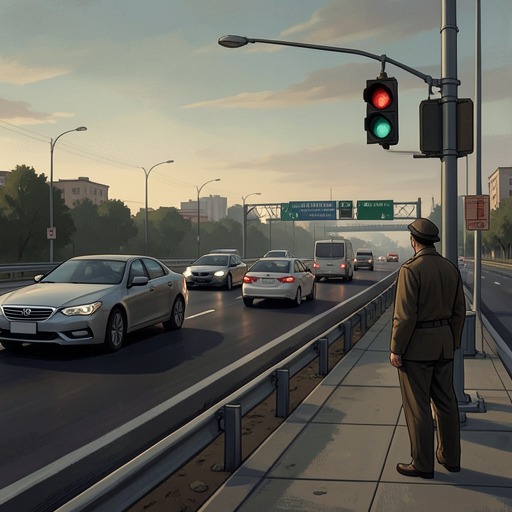
Traffic congestion
The Wisdom of CrowdsTraffic congestion is a coordination failure in which drivers following ordinary, individual rules can produce a slow-moving or stopped highway. The account sets out two complementary truths: pricing can help people coordinate by making the costs of driving more visible, but traffic’s decentralized, tightly coupled movements can turn small disruptions into jams that a toll alone cannot dissolve.
London and the Cost of Driving
In 2002, downtown London was nearly a continuous traffic jam. Each typical day, about a quarter of a million vehicles entered the central eight square miles, competing for narrow, winding streets with a million commuters who used public transportation. Average traffic speed stayed below ten miles per hour and, on bad days, fell to about three. The city’s congestion was not merely an inconvenience for individual motorists: each additional driver added to the delays borne by everyone else.
That burden helped turn London mayor Ken Livingstone, an avowed socialist, into the advocate of a charge for entering downtown. Starting in February 2003, drivers entering central London between 7 a.m. and 6:30 p.m. had to pay £5. The city installed 230 cameras to record license plates; failure to pay could bring an £80 fine. The plan aimed both to raise £180 million a year for public transportation and to reduce congestion by 20 percent.
The economic rationale was that a driver who worsens traffic imposes costs on other road users without paying for them. A motorist trapped in a queue may feel that the time already lost is payment enough, but the toll is meant to collect a cost that the driver otherwise leaves to others. Congestion pricing makes that cost more apparent at the point of choice, when a person can weigh the value of a particular trip against its effects on the shared road.
Pricing as a Coordination Tool
The idea of congestion pricing dates to the 1920s, and economist William Vickrey became its most important advocate. His underlying principle treated road space as a scarce resource whose use should reflect the costs and benefits of people’s decisions. When a main route is free, drivers have reason to choose it during rush hour even if many would be better off traveling at another time, taking public transportation, or working from home. A toll can prompt different choices because the price leads each driver to consider how much that trip is worth to them.
London’s flat £5 charge was a relatively crude version of the system Vickrey imagined. He proposed responsive pricing: the price of using a road could vary with traffic conditions, weather, or vehicle type. If a broken-down tractor-trailer suddenly congested I-5 between Sacramento and San Francisco, for example, a higher price might divert drivers to other routes and keep the jam from growing. Traffic-detecting sensors on highways and global positioning systems in cars make such variable pricing technologically possible, though the account presents it as politically impractical and raises the question of whether highly responsive calculations would be worth their complexity.
The London results were more successful than many people outside economics expected. Traffic fell by almost 20 percent, congestion was significantly reduced, and at least one study found that cars could travel 40 percent faster. That improvement still meant an average speed of only about eleven miles per hour, but the roads remained full of cars. The concern that the scheme had curtailed driving too much missed its purpose: congestion pricing is not meant to empty a road, but to help people balance the benefit of driving against the costs they impose on others. In London, traffic moved more easily and, for the moment, its flow better reflected the value drivers placed on their trips.
How Jams Form and Persist
Pricing can address jams caused by too many cars on the road, but it cannot prevent every disruption to a commute. Accidents, construction, entrance and exit ramps, slight dips, curves, inclines, and a slow truck can all disturb traffic. The account also describes disagreement over whether jams can arise spontaneously, without an identifiable obstacle, or whether every jam begins with a bottleneck, however small.
The basic mechanism begins with free flow. When traffic is light enough, vehicles can speed up, slow down, and change lanes while maintaining safe distances. As more cars enter a highway, or as some slow to exit, drivers brake to preserve those distances. Each driver behind them reacts in turn, sending a wave of braking through the traffic. In faster lanes, drivers must react sooner to maintain their spacing, so those lanes can slow especially quickly. Lane changes fill available gaps and bring lane speeds closer together, but the traffic has already shifted from free movement into an unstable pattern: cars travel at similar, reduced speeds, and little more may be needed to produce stop-and-go conditions.
A jam can outlast the disturbance that started it. Vehicles leaving the front of a traffic jam move more slowly than vehicles joining the back, so the jam itself appears to travel backward along the highway. The account cites traffic researcher Kai Nagel’s observation that, once created, jams can remain stable and move against the direction of traffic for several hours. This persistence helps explain why correcting the original bottleneck may not immediately restore free flow.
The debate over spontaneous jams turns on how traffic is understood. Physicists compare vehicles to water flowing in a river or sand falling through a tube, where smooth movement can suddenly break down; computer simulations show traffic behaving in comparable ways. Traffic engineers instead argue that a jam requires an obstacle or bottleneck, while acknowledging that the cause may be as slight as a car moving too slowly. The distinction is an academic dispute, but either account points to a system vulnerable to small disturbances once it becomes crowded.
Decentralized Drivers, Limited Signals
On a crowded highway, each driver is an individual trying to coordinate with others through simple actions: avoid the car ahead, change lanes when possible, and travel as fast as safety allows. Drivers want to get ahead, but they also benefit when traffic as a whole moves quickly. Unlike a central controller, no driver sees the full pattern of the road or can direct everyone else’s choices.
That limitation becomes critical when lanes move at different speeds. Drivers change lanes more often; the resulting caution makes them leave greater gaps, which can in turn make further lane changes more likely. Each lane may then carry 10 percent fewer vehicles than it could as a single-lane road. Meanwhile, drivers have only brake lights and turn signals to infer what others intend to do. Those signals provide an incomplete picture, so anticipation can become overreaction: one driver braking too readily may slow the entire highway, while decisions about whether to exit or change lanes remain poorly coordinated. The resulting traffic resembles not the patterned movement of a flock, but a stop-and-go tangle.
The chapter frames this account of traffic as a failure to coordinate: pricing can help align individual choices with the costs imposed on others, but it cannot replace the limited, local signals through which drivers respond to one another. Congestion is therefore both a problem of too many vehicles competing for scarce road space and a fragile pattern of interaction, in which small disturbances can spread, persist, and defeat the efforts of individual drivers to move freely.